
Table of Contents
What Is Social Media Marketing?
Social media marketing is the process of using social media platforms to promote a business, product, service, or personal brand. It involves creating and sharing content, engaging with audiences, running paid advertisements, and analyzing performance to achieve specific marketing goals.
It combines several marketing activities, including:
- Creating educational, entertaining, and promotional content.
- Managing business profiles across different platforms.
- Building relationships with followers and potential customers.
- Running paid social media advertising campaigns.
- Generating leads and driving website traffic.
- Monitoring engagement and campaign performance.
- Developing strategies to increase brand awareness and sales.
For example, a clothing business can use Instagram to showcase new collections, Facebook to communicate with customers, and TikTok to publish short product videos. It can also run targeted advertising campaigns to reach people interested in its products.
The main objective is not simply to collect followers. It is to build meaningful relationships with the right audience and turn those relationships into measurable business results.
Why Is Social Media Marketing Important for Businesses?
Customers increasingly use social platforms to discover brands, explore products, read reviews, and communicate with businesses. This makes social media an important channel throughout the customer journey.
Here are some of its most valuable benefits.
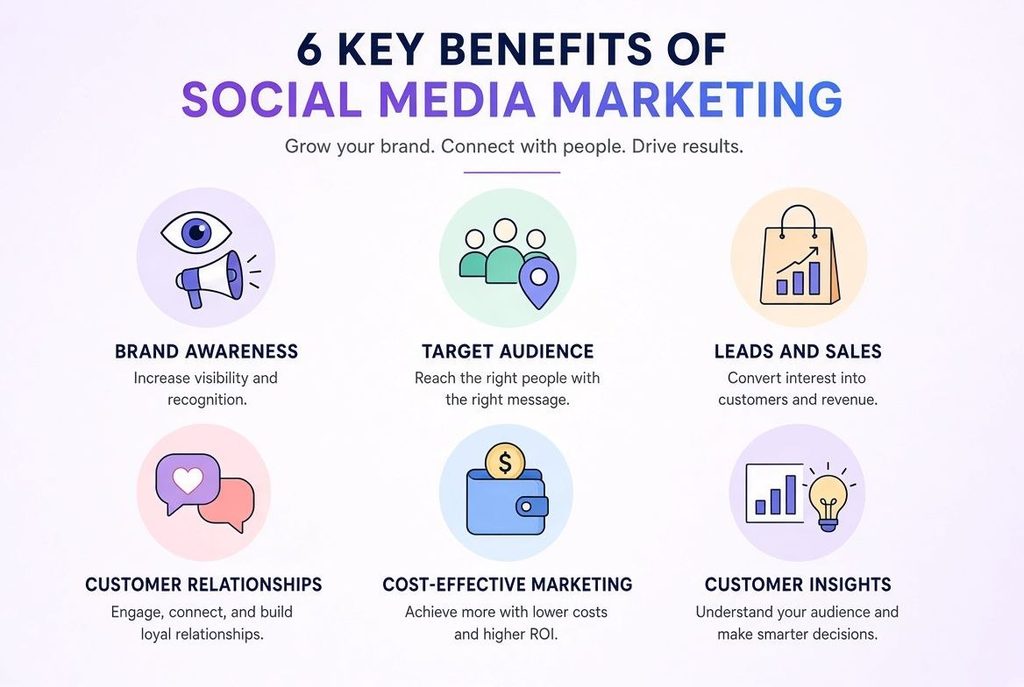
1. Builds Brand Awareness
Brand awareness means how familiar people are with your business and its products or services.
Regularly publishing useful content helps your brand reach new audiences and remain recognizable. When people repeatedly see valuable posts, videos, and educational content from your business, they become more familiar with your brand.
2. Reaches Target Customers
Social platforms offer different ways to connect with specific audiences based on factors such as location, interests, demographics, and online behavior.
For example, a local restaurant can promote its menu to people in nearby locations, while a B2B company can use LinkedIn to connect with professionals and business decision-makers.
3. Generates Leads and Sales
Social media can help businesses attract potential customers through product demonstrations, promotional campaigns, lead forms, direct messages, and website links.
A well-planned campaign can guide potential customers from discovering a product to making a purchase.
4. Builds Customer Relationships
Social media makes communication between businesses and customers easier.
Businesses can answer questions, respond to comments, address complaints, share updates, and collect customer feedback. This direct communication helps build trust and improve customer experience.
5. Supports Cost-Effective Marketing
Compared with many traditional marketing channels, social media offers flexible marketing opportunities.
Businesses can start with organic content and gradually invest in paid advertising when they have a better understanding of their audience and marketing goals.
6. Provides Valuable Customer Insights
Comments, messages, engagement rates, audience demographics, and campaign reports can reveal what customers like, what problems they face, and which products attract attention.
These insights can help businesses improve their products, content, and marketing decisions.
Major Social Media Marketing Platforms
Not every platform is suitable for every business. Choosing the right channels depends on your target audience, industry, content type, and marketing objectives.
Let’s explore the major platforms and their marketing opportunities.
Facebook Marketing
Facebook remains a useful platform for businesses that want to build communities, communicate with customers, share updates, and promote products or services.
Businesses can use Facebook Pages, Groups, Reels, Stories, Messenger, and advertising campaigns to connect with their audiences.
Best for:
- Local businesses and retailers.
- E-commerce stores.
- Restaurants and service providers.
- Community-based businesses.
- Businesses targeting a broad audience.
Instagram Marketing
Instagram focuses heavily on visual content. It allows businesses to showcase products, demonstrate services, share customer experiences, and develop a recognizable brand identity.
Reels, Stories, carousels, and Instagram Shopping features can support different marketing objectives.
Best for:
- Fashion and beauty brands.
- Lifestyle businesses.
- Restaurants and food businesses.
- Creators and personal brands.
- Visual product-based businesses.
TikTok Marketing
TikTok is known for short-form video content and content discovery. Businesses can use it to demonstrate products, share educational videos, participate in relevant trends, and introduce their brands to new audiences.
Authentic and engaging videos can help businesses reach people who are not already following their accounts.
Best for:
- Consumer brands.
- Small businesses.
- Product demonstrations.
- Creators and personal brands.
- Businesses targeting younger audiences.
LinkedIn Marketing
LinkedIn is a professional networking platform that supports business-to-business marketing, professional branding, industry discussions, and lead generation.
Companies can share industry insights, publish educational content, demonstrate expertise, and connect with potential clients.
Best for:
- B2B companies.
- Marketing agencies.
- Consultants and freelancers.
- SaaS businesses.
- Professional service providers.
YouTube Marketing
YouTube allows businesses to publish long-form videos, tutorials, product reviews, demonstrations, educational content, and Shorts.
Video content can also support search visibility because users often search YouTube for answers, instructions, and product information.
Best for:
- Educational businesses.
- Product-based brands.
- Technology companies.
- Content creators.
- Businesses offering complex services.
Pinterest Marketing
Pinterest is a visual discovery platform where users explore ideas, products, inspiration, and planning resources.
Businesses can publish useful Pins that direct users to relevant website pages, product listings, and blog articles.
Best for:
- Home decor businesses.
- Fashion brands.
- DIY and creative businesses.
- Food and recipe websites.
- Lifestyle and gardening blogs.
Important: You do not need to use every platform. Start with the channels where your potential customers are most active and where your business can consistently produce valuable content.
How to Create an Effective Social Media Marketing Strategy
A successful marketing campaign starts with a clear strategy. Publishing content without understanding your audience or objectives can waste time and resources.
Here is a practical process for building a social media strategy.
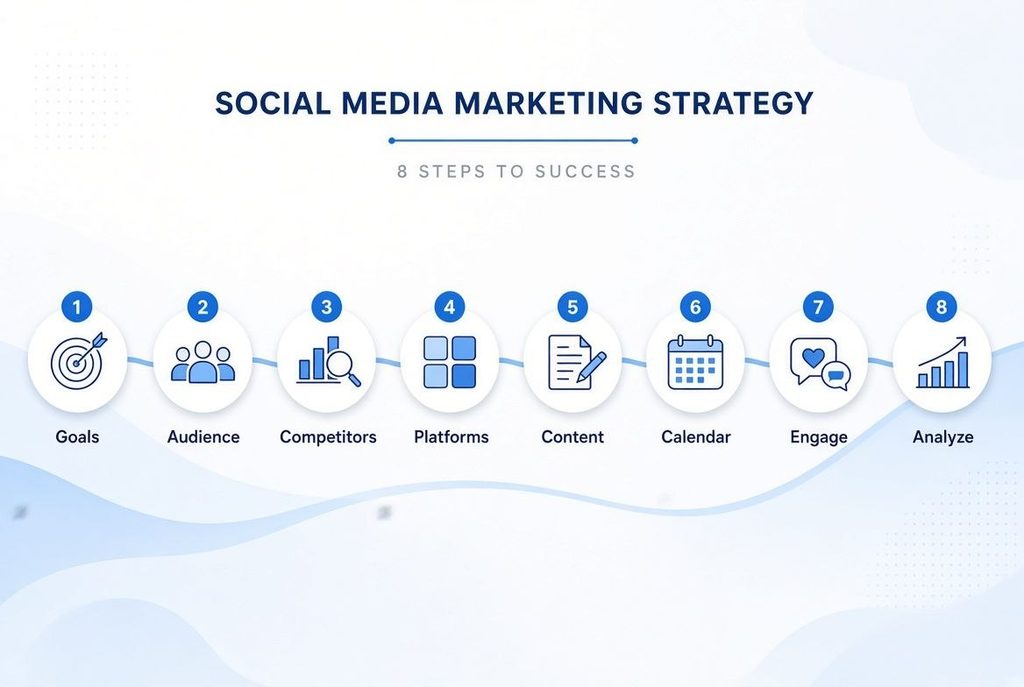
Step 1: Define Your Marketing Goals
First, decide what you want to achieve.
Common social media marketing goals include:
- Increasing brand awareness.
- Growing website traffic.
- Generating qualified leads.
- Increasing product sales.
- Improving customer engagement.
- Building a loyal online community.
- Promoting new products or services.
Your goals should be specific and measurable.
For example, instead of saying “I want more engagement,” set a measurable target such as increasing average engagement by 15% over three months.
Step 2: Understand Your Target Audience
Knowing your audience is one of the most important parts of marketing.
You should understand:
- Age range and location.
- Interests and preferences.
- Professional background.
- Problems and challenges.
- Purchasing behavior.
- Preferred social media platforms.
- Content they regularly consume.
For example, if you provide digital marketing services, your potential customers may include small business owners, startup founders, e-commerce businesses, and entrepreneurs who need help attracting customers online.
Understanding these people allows you to create content that addresses their actual needs.
Step 3: Research Competitors
Competitor research helps you understand what other businesses are doing successfully and where opportunities exist.
Review their:
- Social media profiles.
- Content formats.
- Posting frequency.
- Engagement patterns.
- Promotional strategies.
- Customer feedback.
- Brand messaging.
The goal is not to copy competitors. It is to identify content gaps, understand audience expectations, and develop a stronger marketing approach.
Step 4: Choose the Right Platforms
Select platforms based on your audience and business objectives.
A local retail business may benefit from Facebook and Instagram, while a professional consulting company may prioritize LinkedIn.
Start with one or two platforms, build a consistent presence, and expand when you have enough resources.
Step 5: Develop a Content Strategy
Your content should provide value instead of constantly asking people to purchase something.
A balanced content strategy can include:
Educational content: Tutorials, tips, industry insights, and practical guides.
Engagement content: Questions, polls, discussions, and interactive posts.
Entertaining content: Relatable videos, creative visuals, and relevant trends.
Promotional content: Product features, service descriptions, offers, and customer testimonials.
Trust-building content: Case studies, behind-the-scenes content, customer feedback, and business achievements.
A useful starting point is to distribute content across these categories according to your audience’s interests and campaign objectives.
Step 6: Create a Content Calendar
A content calendar helps you plan what to publish, when to publish it, and which platform to use.
For example:
| Day | Content Type | Objective |
|---|---|---|
| Monday | Educational post | Build awareness |
| Tuesday | Short-form video | Reach new audiences |
| Wednesday | Customer testimonial | Build trust |
| Thursday | Industry tips | Provide value |
| Friday | Promotional content | Generate leads |
| Saturday | Interactive post | Increase engagement |
| Sunday | Weekly recap | Maintain connection |
This is only a sample schedule. Your actual publishing frequency should depend on your available resources and audience behavior.
Step 7: Engage With Your Audience
Social media marketing is not a one-way communication channel.
Respond to comments, answer direct messages, acknowledge feedback, and participate in relevant discussions.
Active engagement helps businesses understand customers and develop stronger relationships.
Step 8: Analyze and Improve Performance
Monitor your results regularly.
Identify which posts generate the most engagement, which campaigns attract qualified leads, and which content formats produce meaningful results.
Use this information to improve future campaigns instead of relying on assumptions.
Organic Social Media Marketing vs. Paid Social Media Advertising
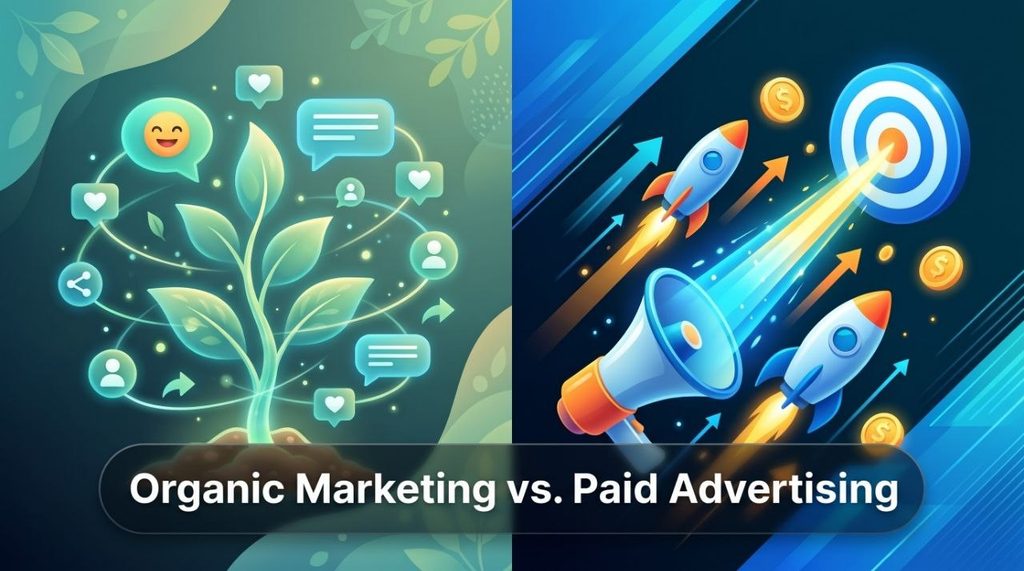
Businesses can promote themselves through organic activities, paid campaigns, or a combination of both.
What Is Organic Social Media Marketing?
Organic marketing refers to activities that do not require direct advertising payments for distribution.
Examples include:
- Publishing regular posts.
- Sharing Reels and short videos.
- Creating educational content.
- Participating in relevant discussions.
- Responding to customer comments.
- Building communities.
Organic marketing is useful for establishing a long-term online presence and developing relationships with customers.
However, reach and visibility can vary depending on platform algorithms, audience behavior, and content quality.
What Is Paid Social Media Advertising?
Paid social advertising involves paying platforms to distribute promotional content to selected audiences.
Businesses can create campaigns based on different objectives, such as:
- Brand awareness.
- Traffic.
- Engagement.
- Lead generation.
- Sales and conversions.
- App promotion.
For example, an online clothing store can run Facebook and Instagram advertising campaigns to promote a new collection and direct interested customers to its website.
Organic vs. Paid Marketing: Key Differences
| Factor | Organic Marketing | Paid Advertising |
|---|---|---|
| Direct ad cost | No media spend required | Requires an ad budget |
| Reach | Depends on distribution and audience | Can be expanded through paid delivery |
| Results | Often develop over time | Can generate faster initial exposure |
| Audience targeting | Mostly content and community-driven | Advanced campaign targeting options |
| Main purpose | Build relationships and visibility | Achieve specific campaign objectives |
The strongest approach often combines both. Organic content builds credibility, while paid advertising helps amplify effective messages and reach relevant audiences.
Best Social Media Marketing Tools for Businesses
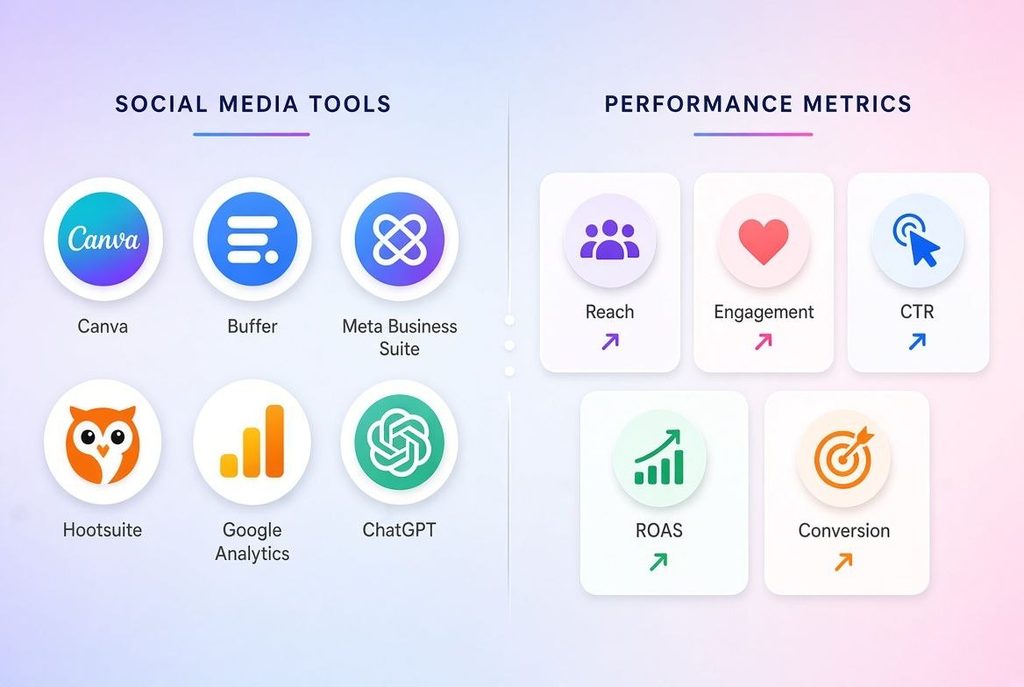
Managing multiple platforms manually can become time-consuming. Social media marketing tools help businesses plan content, design graphics, schedule posts, monitor performance, and manage campaigns.
Here are some useful tools.
1. Canva
Canva helps users create social media graphics, presentations, advertisements, banners, and other visual content.
It is particularly useful for businesses that need professional-looking designs without advanced graphic design skills.
2. Buffer
Buffer helps businesses plan, schedule, and publish social media content across supported platforms.
It can also help organize content ideas and review performance.
3. Meta Business Suite
Meta Business Suite allows businesses to manage supported Facebook and Instagram activities from one place.
It includes tools for content publishing, messaging, notifications, and performance insights.
4. Hootsuite
Hootsuite provides social media management features such as content scheduling, monitoring, and analytics.
It is useful for teams managing multiple social accounts.
5. SocialPilot
SocialPilot supports social media scheduling, content management, reporting, and team collaboration.
It can be helpful for agencies and businesses managing several client accounts.
6. Google Analytics 4
Google Analytics 4 helps website owners understand how visitors interact with their websites.
Businesses can use it to evaluate website traffic, engagement, and conversions associated with their marketing activities.
7. ChatGPT
ChatGPT can assist with content ideas, caption writing, content calendars, audience research, campaign brainstorming, and marketing copy.
However, AI-generated content should always be reviewed, fact-checked, and adapted to the brand’s voice before publishing.
The best tool depends on your business requirements, budget, workflow, and the features you actually need.
Social Media Marketing for Small Businesses
Small businesses often have limited budgets, small teams, and fewer resources than larger companies. However, they can still build a strong online presence with a focused strategy.
Here are practical ways to get started.
Focus on a Specific Audience
Do not try to reach everyone. Identify the customers most likely to purchase your products or services.
For example, a local beauty store may focus on customers interested in skincare, cosmetics, and personal care products.
Highlight Your Products and Services
Use high-quality photos, short videos, demonstrations, and informative descriptions to explain what you offer.
Show customers how your products work and how your services solve their problems.
Use Local Marketing Opportunities
Local businesses can use location-specific content, community groups, customer reviews, and local advertising campaigns to reach nearby customers.
Encourage Customer Reviews
Positive customer experiences can help build trust.
Encourage satisfied customers to share honest feedback and respond professionally to both positive and negative reviews.
Start With a Manageable Budget
You do not need a large advertising budget to begin.
Start with a small, controlled campaign, test different audiences and creative formats, and increase spending when you identify what works.
Maintain Consistency
A consistent brand identity, recognizable messaging, and regular communication help customers become familiar with your business.
The objective is to build a reliable presence rather than publish large amounts of content without a clear purpose.
How to Measure Social Media Marketing Performance
Measuring performance helps you understand whether your marketing activities are producing useful results.
Here are the most important metrics to monitor.
Reach: The number of unique accounts that see your content.
Impressions: The total number of times your content is displayed.
Engagement Rate: The percentage of your audience or reached users who interact with your content, depending on the calculation method.
Click-Through Rate (CTR): The percentage of people who click a link after seeing an advertisement or content placement.
Cost Per Click (CPC): The average amount paid for each ad click.
Cost Per Lead (CPL): The average advertising cost associated with generating a lead.
Conversion Rate: The percentage of visitors or users who complete a desired action.
Return on Ad Spend (ROAS): Revenue attributed to advertising divided by advertising spend.
For example, if a business spends $200 on advertising and generates $800 in attributed revenue, its ROAS is 4x.
Different businesses have different objectives. An awareness campaign should not be evaluated using the same primary metrics as a sales campaign.
Social Media Marketing Mistakes to Avoid
Even well-established businesses can make mistakes that reduce marketing effectiveness.
Here are some common problems to avoid.
- Posting Without a Strategy: Random content makes it difficult to achieve consistent marketing goals.
- Ignoring the Target Audience: Content that does not address customer needs is less likely to generate meaningful engagement.
- Focusing Only on Followers: A large follower count does not automatically translate into leads or sales.
- Overpromoting Products: Constant sales messages can make an account less valuable to its audience.
- Ignoring Comments and Messages: Poor communication can damage customer relationships and reduce trust.
- Using the Same Content Everywhere: Different platforms have different audiences, formats, and content expectations.
- Ignoring Analytics: Without performance tracking, businesses cannot reliably identify successful strategies.
- Expecting Immediate Results: Building a recognizable brand and developing customer relationships usually require consistent effort.
Avoiding these mistakes can make your marketing activities more focused, sustainable, and effective.
Social Media Marketing Services: What Can a Business Expect?
Some businesses prefer to manage their social media accounts internally. Others work with freelancers or professional agencies to handle their marketing activities.
Professional social media marketing services may include:
- Social media strategy development.
- Social media account setup and optimization.
- Content planning and calendar management.
- Graphic design and video content creation.
- Caption and content writing.
- Social media page management.
- Community engagement and customer communication.
- Paid advertising campaign management.
- Audience research and competitor analysis.
- Performance tracking and reporting.
A social media marketing agency may provide several of these services through a dedicated team, while an individual freelancer may specialize in specific areas.
Before choosing a provider, review their experience, portfolio, service details, communication process, reporting methods, and pricing structure.
How Much Does Social Media Marketing Cost?
Social media marketing costs vary depending on the scope of work, number of platforms, content requirements, advertising budget, and level of expertise.
Some providers offer monthly management packages, while others charge separately for content creation, campaign management, consulting, or advertising services.
When comparing social media marketing packages, consider:
- Number of platforms managed.
- Number of monthly posts.
- Graphic and video production.
- Content strategy and planning.
- Community management.
- Advertising management.
- Reporting and performance analysis.
- Additional service charges.
Remember that the advertising budget and management fee are usually separate expenses. Always clarify what is included before selecting a package.
Real-World Social Media Marketing Examples
Understanding practical examples can help you see how different businesses apply these strategies.
Example 1: A Clothing Business
An online clothing store can use Instagram Reels to showcase new products, carousel posts to display product details, and customer testimonials to build trust.
It can also use paid advertising to reach people interested in fashion and direct them to its online store.
Example 2: A Local Restaurant
A restaurant can publish food photography, short preparation videos, customer reviews, menu updates, and special offers.
Location-focused campaigns can help the business reach people who may visit the restaurant.
Example 3: A Digital Marketing Agency
A digital marketing agency can publish educational content about SEO, social media advertising, content strategy, and business growth.
It can use LinkedIn to demonstrate expertise, Instagram to share visual content, and Facebook to connect with small business owners.
Educational posts, practical case studies, and service explanations can help attract potential clients.
Example 4: A Beauty and Skincare Brand
A skincare business can publish product demonstrations, ingredient education, skincare routines, and customer experiences.
This type of content can help customers understand the products before making purchasing decisions.
Frequently Asked Questions About Social Media Marketing
1. What is social media marketing in simple words?
Social media marketing means using platforms such as Facebook, Instagram, TikTok, LinkedIn, and YouTube to promote a business, connect with customers, share useful content, and achieve marketing goals.
2. Which social media platform is best for business marketing?
There is no single best platform for every business. Facebook and Instagram can work well for many consumer brands, LinkedIn is useful for B2B marketing, YouTube supports educational and long-form video content, and TikTok can help brands reach audiences through short-form videos.
3. How much does social media marketing cost?
Costs depend on the business, marketing objectives, service provider, content requirements, and advertising budget. Businesses can begin with organic marketing and gradually introduce paid advertising.
4. How can small businesses start social media marketing?
Start by identifying your target audience, selecting suitable platforms, optimizing your business profiles, creating useful content, engaging with customers, and tracking performance.
5. What are the most important social media marketing tools?
Popular tools include Canva, Buffer, Meta Business Suite, Hootsuite, SocialPilot, Google Analytics 4, and ChatGPT. Each tool serves different marketing needs.
6. What is the difference between social media marketing and social media management?
Social media management focuses on managing social accounts, publishing content, and engaging with followers. Social media marketing is broader and also includes strategy, audience research, paid advertising, lead generation, and performance optimization.
7. How long does it take to see results from social media marketing?
Results depend on the industry, audience, content quality, platform, competition, and marketing strategy. Some paid campaigns can generate initial results quickly, while organic audience growth and brand recognition generally require consistent effort.
8. Should a business hire a social media marketing agency?
Hiring an agency can be useful when a business lacks the time, expertise, or resources to manage its marketing internally. However, businesses should evaluate the agency’s experience, services, portfolio, pricing, and reporting process before making a decision.
Final Thoughts
Social media marketing is more than publishing posts or running advertisements. It is a continuous process of understanding customers, creating valuable content, building relationships, testing strategies, and improving performance.
Whether you operate a small local business, an e-commerce store, a startup, or an established company, the right approach can help you build brand awareness, reach potential customers, generate leads, and support long-term business growth.
Start with clear objectives, choose the platforms that match your audience, develop a consistent content strategy, and measure the results of your activities.
Most importantly, focus on providing value to your audience. When your content helps people solve problems, understand products, or make better decisions, you create stronger opportunities to build trust and turn potential customers into loyal customers.
If you want to improve your online presence but do not know where to start, Mehedi Hasan Digital can help you explore practical digital marketing strategies, social media management, content planning, and online business growth opportunities.
A successful social media presence starts with the right strategy and improves through consistent execution.
Thanks for reading.